Vietnam Safety Guide for Black Travelers (Honest)
Updated: Oct 30
Most travel safety guides treat "is Vietnam safe?" as a simple yes or no. If you are a Black traveler, that question has more layers. You need to know about petty crime and scams, yes, but you also need an honest read on what it feels like to move through Vietnamese cities and towns as a Black person. This Vietnam safety guide gives you both without the sanitized tourism-board spin. Vietnam is genuinely one of Southeast Asia's safer destinations for travelers, but "safer" does not mean "without friction," and pretending otherwise does not serve you.
Table of Contents
Quick Takeaways
Key Insight
Explanation
Violent crime against foreigners is rare
Serious physical crime targeting tourists is uncommon. The real risk is petty theft, scams, and traffic incidents, not violence.
Staring is cultural curiosity, not always hostility
Many Vietnamese locals, especially outside major cities, have limited exposure to Black people. Staring and photo requests are common and rarely aggressive, though still worth addressing on your own terms.
Grab is your safest transport tool
Using the Grab app for both cars and motorbike taxis eliminates metered taxi scams entirely. Always verify the driver and plate match the app before getting in.
Bag snatching from motorbikes is the top theft risk
Keep bags on the shoulder away from the road and hold your phone with a firm grip or use a crossbody bag that sits on your chest side when walking near traffic.
Carry digital and physical passport copies
Leave your original passport in a hotel safe. Police checks are infrequent for tourists, but having a copy prevents major headaches if your bag is stolen.
International clinics exist in Hanoi, Ho Chi Minh City, and Da Nang
Major cities have English-speaking international medical facilities. Outside these hubs, medical access degrades quickly, so travel insurance with evacuation coverage matters.
Skin-lightening product availability does not indicate systemic hostility
Vietnam has a widespread domestic preference for lighter skin rooted in local beauty standards and class history, not specifically directed at Black visitors. Understanding this distinction helps you read social situations more accurately.
What Black Travelers Actually Experience in Vietnam
Let's be direct. Vietnam is not a post-racial utopia. It also is not a country where Black travelers face systematic harassment or danger. The reality sits between those two poles, and knowing exactly where it sits will help you travel more confidently.
The most consistent experience Black travelers report is visible curiosity. In major cities like Ho Chi Minh City and Hanoi, you will attract some stares. In smaller towns, rural areas, and places like Sapa or the Mekong Delta villages, that curiosity intensifies. People may point, attempt to photograph you without asking, or occasionally reach out to touch your hair. None of this is aggressive. All of it can be exhausting, especially on a long trip.
The Hair-Touching and Photo Request Reality
Requests to touch your hair or take photos with you are real. Older locals and children are the most likely to do this. You are absolutely within your rights to say no, clearly and firmly. A simple hand raised, a head shake, and a calm "no, thank you" works across language barriers. You do not owe anyone a photo or physical access to your body, and Vietnamese culture generally responds to a clear boundary without escalation.
In practice, most Black travelers find that Ho Chi Minh City feels the most cosmopolitan and the least likely to produce these moments. The city has a large and growing international community, and locals are more accustomed to a diverse range of faces. Hanoi is more reserved culturally but still manageable. The curiosity curve rises sharply once you leave the major tourist corridors.
Colorism and Its Context
Vietnam has its own domestic colorism rooted in agricultural class history, not in the transatlantic racial framework most Black Americans or Black Britons know. Lighter skin has historically been associated with indoor, higher-status work. You will see skin-lightening products everywhere. This does not mean Vietnamese society is uniformly hostile to dark-skinned visitors. Understanding the local context helps you separate ambient beauty culture from personal disrespect.
That said, some Black travelers do encounter situations where they feel they were quoted higher prices, given slower service, or subtly treated as lesser. These experiences are real and worth acknowledging. In many cases, the better explanation is the general tourist markup rather than race-specific targeting, but that does not make the experience less valid. Document price quotes from local guides or travel forums before you arrive so you know what fair prices look like.
The most useful frame for traveling Vietnam as a Black person is this: you will be seen, you will be stared at, and you will mostly be treated with respect. Prepare for the visibility, and do not let the staring shrink your world.
Petty Crime, Scams, and How to Avoid Them
Petty crime is the real safety concern in Vietnam for any traveler, regardless of race. Pickpocketing, bag snatching, and tourist scams are the issues that are most likely to affect your trip. Violent crime against foreigners remains rare.


Bag Snatching: The Most Predictable Risk
Motorbike theft is a known pattern in Ho Chi Minh City and, to a lesser extent, Hanoi. A motorbike pulls alongside you on the street, a passenger grabs your bag or phone, and they are gone before you process what happened. The fix is straightforward: keep your bag on the side of your body away from the road, hold your phone with purpose and put it away when not in use, and avoid wearing expensive jewelry visibly in busy street areas.
Crowded areas like Hanoi's Old Quarter, Ho Chi Minh City's District 1, and night markets are where pickpocketing is most common. Use a money belt or a bag that closes securely and sits against your body rather than dangling off one shoulder.
Scams Worth Knowing Before You Land
Fake taxis with rigged meters operate in both major cities. Always use Grab or stick to established brands like Mai Linh or Vinasun if you prefer a street taxi. Never get into an unmarked car or accept a ride from someone who approaches you at the airport claiming to work for your booked driver.
The "friendly local" bar scam involves someone striking up a conversation, building rapport, and then steering you to a particular bar or restaurant where you end up with an astronomical bill. This is a coordinated hustle, not a spontaneous friendship. Politely decline invitations to specific venues from people you just met on the street.
Some ATMs have been tampered with to capture card data. Use ATMs located inside bank branches rather than standalone machines on busy streets, and cover your PIN as a baseline habit.
Pro tip: Before you leave for Vietnam, set up a dedicated travel card with a spending limit and use that for ATM withdrawals. Keep your main bank card locked separately. If a street ATM skims your travel card, your exposure is limited and your main account stays clean.
Money Exchange and Pricing Awareness
Currency exchange scams, overpriced taxi rides, and unofficial tour operators are among the most common financial hazards tourists encounter. Research standard prices for your most frequent transactions before you arrive. Know roughly what a xe om (motorbike taxi) ride across the city costs, what a bowl of pho should run at a local restaurant, and what a licensed day tour to a nearby site typically includes.
Getting Around Safely
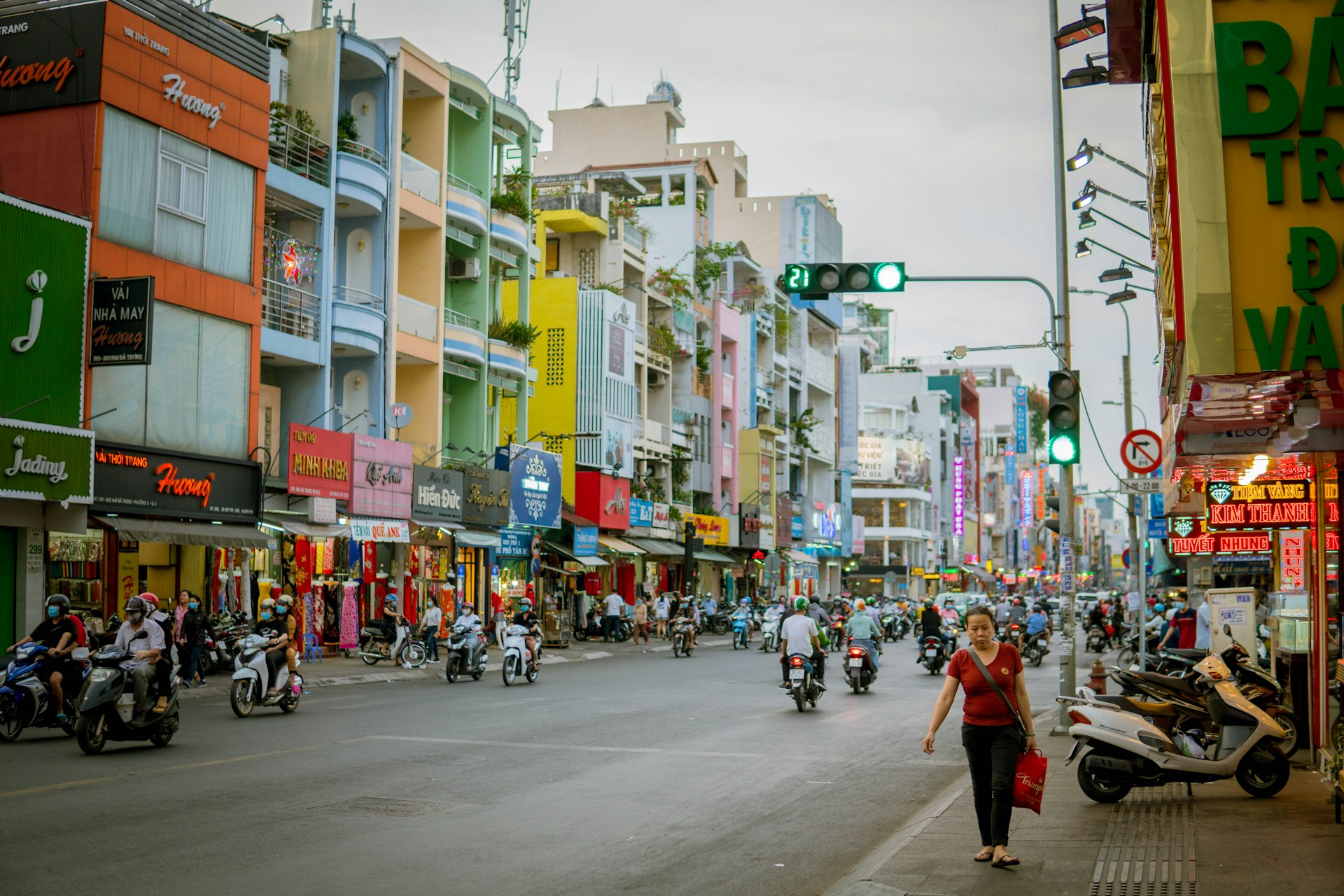
Transportation is where most travel mishaps happen in Vietnam, and this applies to every visitor. The traffic in major Vietnamese cities is legitimately chaotic by most international standards. Motorbikes dominate the road, and they do not behave according to the lane rules or pedestrian norms you probably know from home.
Crossing the Road Without Getting Hit
This sounds basic and is genuinely one of the most important practical skills for your first few days. The key principle is to move slowly and steadily. Motorbike drivers calculate around your movement, so if you freeze, dart, or change pace suddenly, you disrupt their calculations. Step out calmly, make eye contact where you can, move at a consistent pace, and let traffic flow around you. Do not wait for a full gap that never comes.
Motorbikes will use sidewalks, travel against traffic in the same lane, and emerge from between buildings or parked vehicles. Look in every direction, not just at oncoming traffic, and pay extra attention at corners and alleyway entrances.
Using Grab Instead of Street Taxis
The Grab app functions as the dominant ride-hailing platform in Vietnam, operating across both cars and motorbike taxis. For Black travelers, the practical advantage is transparency: you see the price, the driver's name, the plate number, and the route before you commit. There is no meter manipulation and no negotiation in a language you may not speak.
When your Grab arrives, check that the vehicle and driver match the app. Do not accept a substitute driver who claims to be working for your matched ride. This substitution scam exists specifically to move tourists into unregulated vehicles.
Pro tip: Download Grab before you land and set up a payment method while you are still on your home network. The airport arrival process is hectic, and having a working Grab account from the moment you exit customs saves you from negotiating with airport taxi touts when you are jet-lagged and disoriented.

Health and Medical Safety
Vietnam's healthcare infrastructure varies dramatically by location. In Hanoi, Ho Chi Minh City, and Da Nang, there are international hospitals and clinics staffed by English-speaking doctors that are equipped to handle most tourist health situations. Outside these major cities, the quality and accessibility of medical care drops significantly.
Travel Insurance Is Not Optional
Medical evacuation from a remote area of Vietnam, or even from a mid-sized provincial city, can be extremely expensive without coverage. Get travel insurance that explicitly includes emergency medical evacuation. Read the fine print on pre-existing conditions before you buy.
Bring more prescription medication than you think you need, and carry copies of your prescriptions. Sourcing specific medications in Vietnam can be complicated, and pharmacies outside major cities may not carry what you need. Clearing medications with Vietnamese customs requirements in advance avoids delays at the airport.
Food, Water, and Climate
Tap water in Vietnam is not safe to drink. Stick to bottled or filtered water, and be thoughtful about ice at local establishments outside of tourist-facing restaurants. Street food is generally safe if it is freshly cooked and served hot and if there is high turnover. Avoid pre-cooked food sitting out in heat for long periods.
Vietnam's climate varies significantly by region and season. The tropical heat and humidity, particularly in the south and during summer months, can cause real dehydration and heat exhaustion faster than you might expect, especially if you are walking and exploring actively. Carry water, take breaks in the shade, and do not dismiss headaches and fatigue as just tiredness.
Safety by Region: North, Central, and South Vietnam
Vietnam runs over 1,600 kilometers from north to south, and the safety profile of each region differs in ways worth knowing before you build your itinerary.
Hanoi and the North
Hanoi's Old Quarter is the most visited area in the north and carries the highest pickpocket risk in the city. It is also genuinely one of the most interesting neighborhoods in Vietnam, so the answer is not to avoid it but to be prepared. Use secure bags, keep valuables distributed across pockets, and stay alert in the narrow alleys where crowds compress.
Ha Long Bay, a major tourist destination near Hanoi, has its own specific scam pattern involving boat operators: the boat you see in promotional photos and the boat that shows up are not always the same. Book through reputable licensed operators and check recent independent traveler reviews before committing. Paying slightly more tends to produce significantly better and safer experiences on the water.
Central Vietnam: Hue, Hoi An, Da Nang
Central Vietnam is generally calmer than the south in terms of hustle and scam density. Hoi An in particular has a relaxed atmosphere, though it has become heavily touristed, which always brings some opportunistic pricing. Da Nang has a growing international infrastructure and is a reasonable base for exploring the region. Hue is culturally rich and somewhat lower-key for tourists.
Ho Chi Minh City and the South
Ho Chi Minh City is Vietnam's largest and most dynamic city, and it is also where the scam and petty theft risk is highest. District 1, the main tourist district, sees the most bag snatching, fake taxi activity, and bar scams. This is also where you are most likely to encounter other Black travelers and expats, which can make it feel simultaneously more familiar and more chaotic.
The Mekong Delta and coastal towns like Nha Trang and Mui Ne are popular tourist extensions from HCMC. Nha Trang in particular has a reputation for being more tourist-hustle-heavy than other coastal towns. Go in with calibrated expectations.
Approach Comparison: How to Handle Common Safety Situations
Situation
Passive Approach
Recommended Approach
Unwanted photo request or hair-touching attempt
Freeze up, comply uncomfortably, or ignore it and feel resentful for the rest of the day
Raise a hand, give a firm "no" with a head shake, and move on without extended explanation. Clear boundaries land better than apologies.
Hailing a taxi from the street
Accept the first driver who approaches, assume the meter is accurate
Open Grab, book a ride with full price transparency, verify the driver and plate before getting in.
Crossing a chaotic intersection in Hanoi or HCMC
Wait for a complete gap that never arrives, then panic-sprint
Step into traffic calmly, move at a steady pace, make eye contact with drivers, and let motorbikes flow around you without sudden changes in speed or direction.
Plan it with the Black Travel Network
Read our Saigon guide — neighborhoods, costs and what it is really like for Black travelers.
Hanoi, Da Nang and Hoi An guides on Black in Asia.
Watch Black creators in Vietnam — Jay & Sara, Paint Your Lifestyle and more on BlackTraveler.tv.
Get the free 72-hour Asia guide — airport, money, SIM and your first three days.
We earn a commission if you book through these links, at no extra cost to you.
Some links are affiliate links. Booking through them costs you nothing extra and keeps these guides free.
Frequently Asked Questions
Is Vietnam safe for Black travelers specifically?
Vietnam is generally safe for Black travelers. The primary risks, including petty theft, scams, and traffic accidents, apply to all tourists regardless of race. What is specific to Black travelers is the experience of heightened visibility, staring, and occasional curiosity-based physical contact. These experiences are worth preparing for emotionally and practically, but they are categorically different from physical danger.
Will I face racism in Vietnam?
You may encounter colorist attitudes and moments of cultural ignorance rather than the organized racism that Black travelers might associate with certain other countries. Some travelers report feeling subtly sidelined or priced differently in tourist contexts. These experiences vary by region, individual encounter, and how well you can navigate cultural differences in real time. Major cities are more cosmopolitan and less likely to produce these moments than rural or small-town environments.
Is it safe to use street food stalls as a Black traveler?
Yes, street food is generally safe if you follow basic practices: eat at stalls with high customer turnover, choose food that is cooked fresh in front of you, and avoid pre-cooked items sitting out in heat. The safety calculus here is the same for all travelers. Some Black travelers report occasionally being charged more at tourist-facing restaurants, so knowing local price ranges before you order helps you spot significant overcharges.
What should I do if I experience a theft or scam in Vietnam?
Report it to the local police, though be aware that police responsiveness to tourist complaints varies and is not always reliable. File a police report regardless, as you will need it for any travel insurance claim. Contact your embassy or consulate if your passport is stolen. Keep digital copies of your passport and travel documents stored separately in cloud storage so you can access them even if your phone and bag are both taken.
Which Vietnamese cities are the most comfortable for Black travelers?
Ho Chi Minh City tends to be the most cosmopolitan and the most accustomed to international diversity, which generally makes it the most comfortable in terms of not standing out. Hoi An and Da Nang in central Vietnam are popular with international travelers and have relatively relaxed atmospheres. Smaller towns and rural areas will bring more visibility and curiosity. None of these destinations are unsafe, but your experience of visibility changes significantly between them.
Do I need travel insurance for Vietnam?
Yes, and treat this as non-negotiable rather than optional. Medical care in major Vietnamese cities is accessible, but medical evacuation from remote areas, or treatment for serious conditions, can carry significant costs without coverage. Choose a policy that explicitly covers emergency evacuation, and read the exclusions carefully before purchasing.
If you have traveled Vietnam as a Black traveler, we would genuinely love to hear what your experience was like and whether the advice here matched your reality on the ground.
We would love your feedback and any insights you would share with others. What perspective would you add?
References
Rough Guides overview of crime and safety risks for travelers in Vietnam
U.S. Department of State travel advisory and safety guidance for Vietnam
Practical safety guide for travelers in Vietnam covering scams and transport
CDC Yellow Book 2024: health and safety information for travelers visiting Vietnam
Independent traveler safety breakdown for Vietnam including city-level risk ratings


Comments